Glossary
Explanations of neurodivergent terminology in an affirming context

These are predictable, comforting foods that do not trigger sensory sensitivities and ease anxiety. Keeping “safe foods” on hand ensures that young people still get the calories and nutrients they need.
The person to whom a neurodivergent person can turn for predictability, understanding, and unconditional acceptance. This is the person who usually sees and has to find a way to safely navigate the challenging and/or dangerous behaviour that stems from masking around others.
A place where a neurodivergent person can fully and freely be themselves without fear of reprisals or being found deficient when measured against neurotypical standards.
Refers to the autistic tendency to eat the same food very frequently or even exclusively for days, weeks, even months at a time; it often needs to be prepared in an extremely specific way, eaten in a ritualistic manner, or may only be a specific brand. Anything outside of these criteria is Not Right and does not satisfy the samefood need.
A temporary, targeted support that helps young people learn new skills, with the goal of gradually removing the support as they become more confident in the skill.
This term is the pathological/medical model framing of a neurodivergent person’s inability to attend school (school-induced trauma); it centres the blame within the child and implies that a child is making a conscious choice, out of ‘bad behaviour,’ to be obstinate about attending school. Framing it this way invalidates the internal experience of the child/young person and places all responsibility for ‘fixing’ the situation onto that child and their family.
The pathologized/deficit model terminology for this is ‘school refusal’ or Emotion Based School Avoidance (EBSA). SIT is the affirming term for explaining the neurodivergent experience of distress caused by the school environment; the term SIT honours the neurodivergent reality that these young people are unable to attend school due to distress caused by the environment, not a dysfunction centred in the child.
Planning out in advance what to say and rehearsing that scripted interaction over and over in order to minimise perceptions of awkwardness or social-misalignment in the moment.
A broad term for activities undertaken for the sole purpose of looking after personal physical, emotional, and mental health.
Showing oneself compassion, understanding, and love, particularly when experiencing personal difficulties or self-criticism.
An outward expression of emotional distress in which the individual harms themselves as a way of managing those emotions; it is often a way of feeling in control of at least one thing when everything else is uncontrollable and unpredictable.
A person who sometimes, but not always, uses mouth words to communicate.
The ways through which our bodies experience the world, internally and externally, and interacts with our environment
Necessary for receiving, processing, and responding to sensory information from all senses (sight, sound, taste, smell, touch, balance, inside sensations, sense of body in space).
Any stimulus which is derived from our environment. For example, light levels, sound levels, visual input.
When the sensory experiences of an individual are disbelieved or disregarded by others.
The experience of sensory bombardment and overwhelm due to the inability to escape a chronic stressor, including the invalidation of this experience by others.
A metaphor used to describe the way a child suppresses their distress and anxiety, increasing their internal pressure, while in an unsafe environment (such as school) and then releases it all once they’ve moved into a safe environment (such as home). This looks like meltdowns, swearing, throwing, hitting, self-harming, crying, and so on.

An internalised physical overwhelm and trauma response to a combination of too much sensory information and dysregulated emotions (including frustration, anger, sadness, happiness, and excitement). This is not a choice, it is not ‘challenging’ behaviour, and it is not a ‘tantrum.’ It is not done on purpose; it reflects that the individual is in survival mode.
A form of anxiety/distress in which individuals become unable to use verbal communication; this usually occurs within specific environments or contexts. Not speaking is not a conscious choice being made, it is a physical/emotional response preventing the use of mouth words.
Situational mutism is not the same as verbal shutdown or Apraxia.
Any conditions that affect quality, timing, or duration of sleep. Child sleep problems will also impact parent/carer sleep.
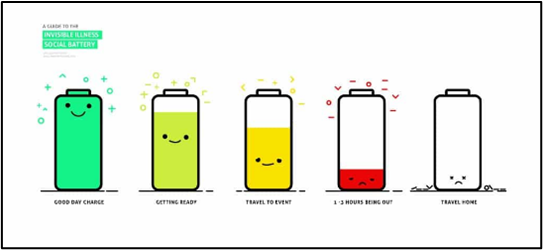
Akin to Spoon Theory, this metaphor describes a person’s finite reserve of energy that can be spent on social interactions. Different interactions drain the battery at different rates; when it is down to 0%, the person has no choice but to withdraw and recharge. We can protect the energy levels through Pacing.
Necessary for receiving, understanding, and applying rules of social interaction in various settings and with different groups of people.
Created by Carol Gray in 1991, social stories are short descriptions of a particular situation, event or activity, which include specific information about what to expect in that situation and why. They are often presented as a comic strip/cartoon. The correct use of social stories is to inform and prepare someone for a new event or experience NOT to force compliance of ‘rules.’
Raises awareness of the societal barriers (environments, structures, attitudes) that further disable and restrict the lives of disabled people.
Ways of being and behaving that are deemed to be acceptable within a specific culture, environment, or social group.
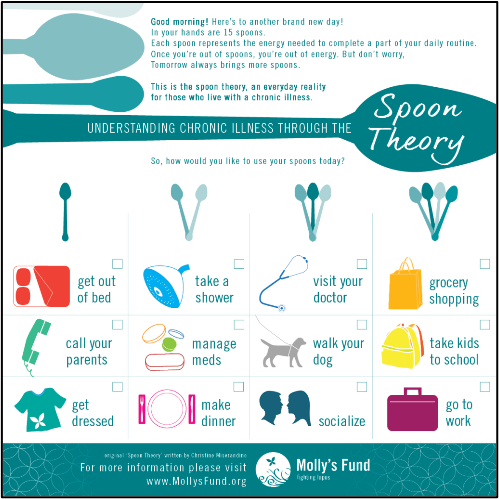
Popular metaphor within the disability community that describes the economy of living with a variety of physical conditions (ex. chronic fatigue, chronic pain, mental health) and how it requires a person to choose carefully on what they spend their spoons. Choosing where to spend spoons is captured within the concept of Pacing.
A set of negative and often unfair beliefs that a society or group of people have about something or someone.
Self-stimulatory behaviour, also known as stimming and self-stimulation, is the repetition of physical movements, sounds, or words, or the repetitive movement of objects to achieve emotional and sensory regulation. It is a necessary tool for neurodivergent people, used as an adaptive mechanism that helps them to soothe or communicate intense emotions or thoughts. Attempting to eliminate stimming is harmful.
Frequently the aim of ABA and other behaviour modification ‘therapies,’ stim redirection is attempting to alter the presentation of a stim to meet neuronormative expectations. This can sometimes be necessary for dangerous or harmful stims; when that is the case, there are neuro-affirming ways to manage it.
Repetitively listening to a single song, playlist, audio file, etc.
Repetitively watching the same media (usually digital).
Personal character traits considered to be positive and/or useful.
Stress that results from the accumulation of various stress factors including: heavy workload, poor communications, multiple frustrations, coping with situation of disempowerment, and the inability to rest or relax. This type of stress is compounded by the disabling aspects of daily life, including having to manage inaccessible systems, constant requirement to mask, and unpredictability in social and sensory environments. The result of this relentless stress over time is trauma that can lead to exhaustion, shutdowns, or health crises.
A broad term used to describe a wide range of contemplations and preoccupations with death and suicide.
When neurodivergent people work together to fill the gaps in each other’s spiky profiles and support each others’ needs, i.e. one friend reminding the other to take their medicine while the other reminds them to drink their water. This is sometimes called ‘sharing spoons.’
This means working with the autistic person to understand their specific need and then implementing a strategy that works to meet that specific need.
Actively preventing something from being seen or expressed; a key tenet of ABA and other behaviour modification ‘therapies.’
When sensory stimuli are processed in a mixed way, i.e., hearing colours or seeing certain smells.
Issues and concepts that are pervasive and deeply embedded throughout the systems and functions (education, health care, social care, justice, policies and practices, established beliefs and norms, unspoken expectations, standards for building design, etc.) that make up the fullness of living within a specific culture.