FAQs
Answers to the most commonly asked questions

The aim of the Highland ND Hub is to provide routes to reliable and affirming information on neurodivergence for families, professionals, and anyone else who is interested. It will provide links to trustworthy resources, signpost to dependable support services, and offer a thorough understanding of the lived experience of neurodivergence.
There are dozens of neurodivergent experiences. This website will provide understanding of the five that are generally considered within the clinical neurodevelopmental assessment in the Highland Council, which are:
– Attention Deficit Hyperactivity Disorder (ADHD)
– Autism Spectrum Disorder (ASD)
– Developmental Coordination Disorder (DCD)
– Developmental Language Disorder (DLD)
– and Fetal Alcohol Spectrum Disorder (FASD)
We also touch upon Learning Disability, learning difficulties, and learning differences.
The Highland Council and NHS Highland are working together to design and agree a new diagnostic pathway for neurodivergent children in Highland. As we receive updates, we will share the information here.
In collaboration with The Highland Council, NHS Highland is currently reviewing and redesigning the NDAS service in the Highland Region, which will include enhancing transition pathways to adult services. If a young person is 18 years old and already on the waitlist NDAS will retain their referral until further clarity is established, at which point we will contact them directly. The original referral date to NDAS will be honoured should a young person be referred onwards to adult services.
Thriving Families can help you decide what you want to say and make a plan for saying it. If what you need is someone sitting with you at the table, there are advocacy services that can attend meetings; information on these advocacy services is available in the Thriving Families Resources section.
That is a GREAT question! In brief, ‘neurodivergence’ is when a brain develops and functions differently to how the majority of people expect it to function. It is a very nuanced topic, though, so we’ve created several different resources tailored to specific users to help explain it and ensure you feel comfortable with it, with whatever level of understanding you are starting.
Find more information here:
– Parents/Carers – What is Neurodivergence?
– Children & Young People – What is Neurodivergence?
– Professionals/Educators – What is Neurodivergence?
– Quick Start Guide – Neurodivergent Experiences
A LD is defined as having an IQ below 70, though it is now uncommon for IQ assessments to be routinely conducted. Around 30-40% of autistic and/or ADHD children will also have a LD.
In contrast, a learning difficulty (SpLD, short for Specific Learning Disability) does not affect IQ. It is a specific challenge in academic learning due to a particular difference in the way the brain best takes in and processes information. SpLDs include:
– Dyslexia (difficulties with reading and writing);
– Dyscalculia (challenges with number recognition, arithmetic, & calculations);
– Dysgraphia (problems with handwriting);
– Developmental Coordination Disorder (issues with fine & gross motor skills);
– Developmental Language Disorder (difficulties in understanding and processing language)
While many neurodivergent children and young people do not meet the criteria for a learning disability diagnosis, they are still likely to experience struggles with learning due to their neurodivergent traits, such as:
– Being self-directed learners who find it easier to engage with topics within their own preferences;
– Being unable to shift and direct their focus when instructed by others
– Needing to move up, down, and all around in order to do their best thinking
– Being overwhelmed by the sensory environment
– Experiencing significant anxiety in social relationships, including with teachers and peers
– Experiencing confusion when directions are not literal and direct
No. The Pines is not a dedicated space for neurodevelopmental support services; it is an office building that houses many different Highland Council and NHS Highland employees and some other services. This means there isn’t necessarily someone who will be there to speak with you about your child. Each of the individual services are contactable directly. If you aren’t sure who you need to speak with but know you need help, you can call Just Ask for guidance.
There are many different support lines out there. If you aren’t sure who you should be talking to, you can start with calling Just Ask to get their advice on which service best meets your needs. Direct contact information for each of the relevant services can be found here. If you need help with understanding your child’s legal rights, Enquire has a plethora of useful pamphlets. If what you need is someone to listen and help you make a plan, you can contact Thriving Families.
The transition from child services to adult services can be daunting. Knowing where to go can ease some of that trepidation. If ever in doubt, you can always go to your GP for some direction. Information on adult services is available via these links:
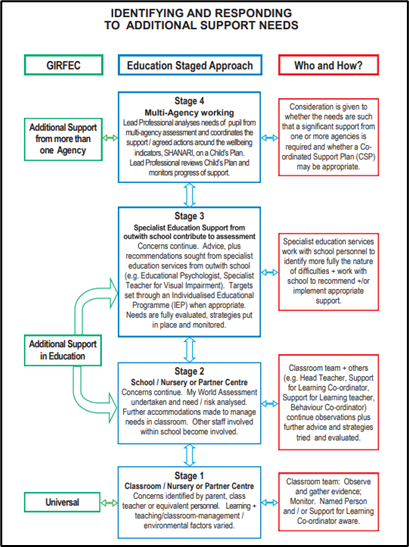
The Practice Model guides everyone who works with children and young people in Highland in how to best support each individual to improve outcomes. It supports the Scottish Government’s “Getting it Right for Every Child” policy. As stated in the Highland Child Protection and GIRFEC Guidance 2024, the Practice Model “is a dynamic and evolving process of assessment, analysis, action and review, and a way to identify outcomes and solutions together with children or young people.”
This means that there are (somewhat loosely defined) specific stages of support that are supposed to be followed to meet an individual child’s needs. These stages move from simple classroom strategies (Early Stages), to bringing in specialist insight and understanding (Escalation), on to complex need support (Multi-agency Involvement). In practice, it means that certain strategies should be tried before advancing to other ones. Enquire explains the stages of support very well.
This graphic shows the Practice Model framework.