Glossary
Explanations of neurodivergent terminology in an affirming context

A research-based framework that details and quantifies the process of gestalt language development from Stage 1 (use of language gestalts) to Stage 6 (culminating in a complete grammar system); NLA is not a ‘practice,’ but a description of the natural, developmental process of gestalt language development, and provides a road-map for supporting children in natural, conversational, developmentally-appropriate ways.
The narrative based around the medical model and deficits, which portray neurodivergent people as ‘less’ due to their neurology and pushes them towards neurotypical standards in order to find acceptance.
A development of the brain’s systems and networks, which influences an individual’s information processing; this includes how they learn, read, socialise, remember, and pay attention.
The natural variations in how people’s brains develop and function, leading to diverse ways of thinking, learning, and behaving; importantly, every variation is equally valid to the others – no one way is superior to another.
When a person’s brain develops and functions in a way that results in them thinking, processing information, and behaving differently to societal expectations. This may be differences in social preferences, ways of learning, ways of communicating and/or ways of perceiving the environment.
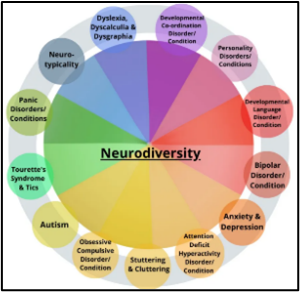
The concept that all humans have a unique neurological make-up and that this forms an infinite spectrum of human cognition; it is a term for a group of people with mixed neurotypes, which includes neurotypical people.
A social justice movement that pushed for moving away from the medical model of pathologizing mental, developmental, and cognitive disability and towards full acceptance of natural variations in neurology; this movement started in the 1990s when autistic people began finding each other online and realised they shared frustration at being characterised as tragic, broken versions of ‘normal’.
The Neurodivergent Paradigm is philosophical basis underpinning the Neurodivergent Movement; it was developed by Nick Walker (2021) working with other Autistic and Neurodivergent academics and activists to give an underpinning to the more activist, rights-based Neurodivergent movement.
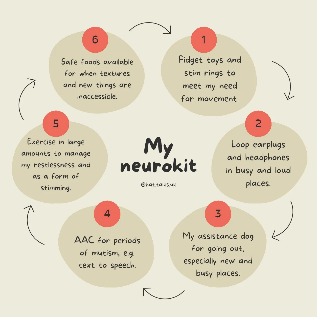
Specific items that support a neurodivergent person in their daily life.

As defined by Kieran Rose (The Autistic Advocate): The systemic imposition of neurotypical norms, values, and ways of being, positioning them as superior, universal, and inherently human. It is an interpersonal assumption of experience, norms, values, and ways of being as inherently neurotypical; a form of cognitive colonisation that frames neurotypical experiences as the benchmark against which all other neurological experiences are judged, measured, and controlled.
The science that looks at the nervous system (including the brain) and how it works and interacts with the world.
A set of standards that focuses on the needs of individuals who could be considered neurotypical.
The societal expectation and belief that neurotypical ways of processing and experiencing the world are superior to other ways of being.
A neurotype refers to the type of neurocognitive make-up of a person; neurotypes are a way of explaining neuro-cognition and embraces the idea of a spectrum of minds. Neurotypes are not always static, and people may move between neurotypes. Neurotypical and Neurodivergent are neurotypes.
Also known as Predominant Neurotype (PNT) or Neuronormative (NN); when a person thinks, processes information, and behaves in ways that are typical or expected within their culture.
Individuals who do not communicate using mouth words (normative oral verbalism).
As defined by Robert Chapman in his book, ‘normality’ is the set of scientific, institutional, cultural, and legal impositions that define what is considered pathological and what is deemed normal, based on its alignment with the presumption that a person’s purpose is to be productive.