Glossary
Explanations of neurodivergent terminology in an affirming context


The repetition of sound, words, or phrases, i.e. repeating a phrase you’ve just heard, repeating a line from your favourite film, repeatedly pressing a button on a device which elicits a sound. This repetition can be external or internal. Echolalia plays a key role in Gestalt Language Processing; the repeated sound has a meaning to the speaker, even if that meaning isn’t understood by those around them.
A group of genetic disorders affecting connective tissue, leading to symptoms like flexible joints, stretchy or fragile skin, and easy bruising; the most common type is Hypermobile EDS (hEDS). It is a very common co-occurring condition for neurodivergent people.
Also known as ‘school refusal,’ this is the pathologized/deficit model term for when children or young people are unable to attend school due to environmental pressures. The affirming term is School-induced Trauma (SIT).
Needed for understanding one’s own emotions and those of other people, as well as for managing emotions safely.
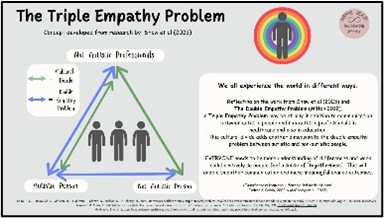
The ability to understand and share the feelings of another; the pathological framing of autism often describes autistic people as being deficient in empathy because the expression of autistic empathy looks different to the expression of neurotypical empathy.
Refers to a breakdown in mutual understanding between any two people due to different life experience; within the context of breakdowns in understanding between neurotypical and neurodivergent people, it refers to the assumption that this breakdown is always the fault of the neurodivergent individual. It is in this inaccurate assumption that the root was formed for describing autism as “a social communication disorder.”
Acknowledges the friction of communicating between semiotic domains, i.e., professionals perceiving parents as having a lack of understanding because they don’t use the accepted terminology of a specific field; this compounds the issues related to the double empathy problem, resulting in epistemic injustice.
Supporting others (individuals or groups) to discover and implement their own freedoms, personal power, and agency.
A neurological condition which is characterised by re-peated seizures. There is a high prevalence of co-occurrence of autism and epilepsy.
Harms that relate specifically to how we are trusted, believed, and valued as knowers, interpreters, and providers of information. This concept was defined by Miranda Fricker (2007), who identified two key forms of epistemic injustice: testimonial injustice (where testimony is unduly dismissed because of prejudiced beliefs regarding minority groups); and hermeneutical injustice (where a community’s shared vocabularies have been structured in a way that unfairly distorts or stifles understanding for, and of, a minority group).
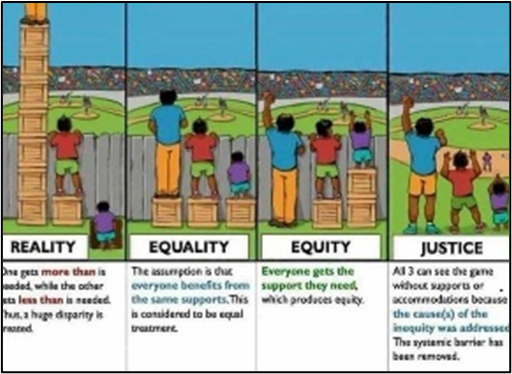
The right of distinct groups of people to have a similar social position and receive the same treatment.
The process of redistributing access and opportunity to be fair and just; the state of being free of bias, discrimination, and identity-predictable outcomes and experiences.
The scientifically inaccurate theory that humans can be improved through selective breeding of populations; it is linked to historical and present-day forms of discrimination, racism, ableism, and colonialism. The implementation of eugenics practices has caused widespread harm, particularly to populations that are being marginalized, including neurodivergent and disabled people.
The process of identifying the best available evidence to make decisions about practices that should be deployed to support individuals in a given population (McKibbon, 1998, see Vivanti, 2022). Practices that meet a predefined set of evidentiary criteria are labelled “evidence-based practices” to promote their adoption by service providers. However, there are no independent standards or bodies to regulate what qualifies as “best” or “high-quality” evidence. This is why, when using recognized standards failed to find any support for widely promoted autism interventions, autism researchers unethically responded by lowering or discarding standards for autistics, to accommodate the extremely poor quality of the autism intervention literature. Also, no EBP framework considers whether intervention researchers should measure or report on adverse events (unintended negative consequences of interventions that can cause short- or long-term harms).
EF is how the brain initiates tasks; it is a set of cognitive processes that help people self-regulate so they can effectively plan, prioritize, and sustain effort toward their goals. EF is operated from the Pre-frontal Cortex of the brain and is literally shut down when the Amygdala (the brain’s environmental threat detector) is triggered, which means people are incapable of being rational or making choices in those moments.
Hands-on, learning by doing, and reflecting on what one has done; strong elements of it include students having meaningful voice and choice in what they do, connecting with the community, and being involved in projects with real-world value. The term was coined by John Dewey in the early 1900s.
A behavioural treatment based on the premise that someone’s fears are irrational rather than valid experience-based concerns; it gradually exposes people to feared objects, situations, or activities to help them confront and overcome anxiety or trauma. When used on neurodivergent people who have a hypersensitivity (i.e., forcing a young person to sit in the canteen to ‘help them get used to it’), it causes trauma.
Direct visual contact with another person’s eyes. Many autistic people find eye contact uncomfortable and intrusive, and not making eye contact can reduce stimuli and support auditory processing. Eye contact is not required for listening or concentrating.