Glossary
Explanations of neurodivergent terminology in an affirming context


Allowing for a period of time that is low demand and low arousal for a neurodivergent person to recover from earlier experiences of pressure and overwhelm. Periods of decompression are critically important to ensure emotional regulation and to avoid crisis (meltdown/shutdown).
Consists of applying firm tactile sensory input to provide proprioceptive input to the whole body in order to regulate sensory systems, reduce anxiety, soothe body stress responses, and create a feeling of calm.
States that an individual’s difficulties are expressions of fault within them that must be fixed; the function of deficit ideology is to justify existing social conditions by identifying the problem of inequality as located within, rather than as pressing upon, disenfranchised communities so that efforts to redress inequalities focus on “fixing” disenfranchised people rather than the conditions which disenfranchise them (Weiner, 2003; Yosso, 2005).
Denying the attribution of human qualities to a person or a specific group of people.
A neutral term that can be used in place of the deficit-based term Pathological Demand Avoidance.
Purposefully reducing demands and language which sounds demanding to facilitate restoration of power balance and/or sense of control and autonomy to a neurodivergent person.
A common mental health condition that negatively affects the way one thinks, creating a feeling of low mood and often a loss of interest in previously enjoyed activities, having a significant effect on day to day life. When it goes on for long periods of time or returns regularly, it is considered to be Clinical Depression.
This is a common developmental difference affecting fine and/or gross motor coordination in children and adults.
This is the current internationally recognised diagnostic term for people who have difficulties understanding and using language. The criteria for diagnosis relate to difficulties being present through all of life (developmental, not acquired), having a functional impact on daily life, and have no other explanation (i.e., autism, Deaf/Hard-of-hearing, etc.). It replaces previous terminology such as Specific Language Impairment, Language Disorder, and Language Delay.
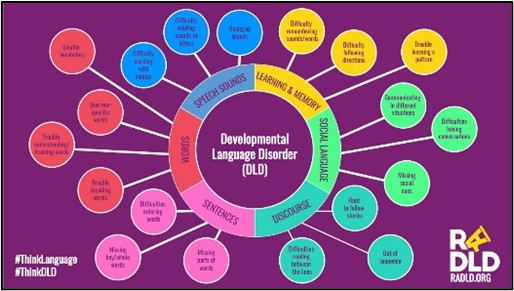
The dominant way through which diseases, illnesses, and disabilities are labelled, discussed, understood, and ‘explained’ within biomedicine. A diagnosis is both a category and a process (Blaxter, 1978). Diagnoses serve several functions within and for biomedicine, including 1) creating a language for discussing and addressing health and disorder and 2) determining the allocation of resources and supports, shaping of research, and one’s access to health services (Jutel, 2017a, p. 139).
This therapy focuses on four components: mindfulness, interpersonal effectiveness, distress tolerance, and emotional regulation. However, the interpersonal effectiveness aspect can be problematic for neurodivergent people. When used correctly, DBT does not focus on compliance or changing who a person is; it gives people the skills to identify as well as regulate their emotions, find ways to manage their distress, and recognise, fulfil, and advocate for their needs.
Having distinct properties, which are neither superior nor inferior to other properties.
Any way in which changes are made to the content, presentation, environment, or expectations for a young person in a teaching and learning setting.
Any condition that makes it more difficult for a person to do certain activities and interact with the world around them. “Disability” and “disabled” are indicators of culture and identity; “disabled person” is an accepted term.
A disconnect from your bodily state and sometimes the world around you; usually a trauma response.
A term for describing a group that displays a range of differences, whether that is in neurotypes, race, gender, sexuality, etc.
The neurotransmitter responsible for feelings of pleasure, the regulation of attention, and being able to be at ease; groups can be diverse, individuals cannot.
ADHD brains experience this deficiency, meaning their brains are always craving it; much of ADHD-related impulsivity and risky behaviour can be attributed to seeking dopamine releases.
This is a difficulty in understanding and working with numbers. It can present as difficulties with naming, ordering numbers, comparing physical quantities, estimating, and identifying place values. It is more common to have a specific learning difficulty in Maths-related processing than it is to be dyscalculic.
A genetic, brain-based difference that impacts the way a person processes written information both on the way in and the way out. The four areas of processing that are impacted are phonological awareness, verbal memory, processing speed, and visual processing. Dyslexia is technically not a learning disability; it is categorised in pathological terms as a learning disorder. Described in neuro-affirming language, it is a learning difference that requires tailored support directed by the individual’s self-stated goals.
This is the old term for Developmental Coordination Disorder. It is a common developmental difference affecting fine and/or gross motor coordination in children and adults.