Autonomy, Bodily
The right of people to control what happens to and with their own bodies.

The right of people to control what happens to and with their own bodies.
Having the freedom and ability to make your own choices and control your own life.
Anxiety/stress shuts down cognitive function preventing words from forming in the mind or making their way through your mouth.
A way of checking in with and understanding how things are with another person, characterised by asking the same question over and over in order to ensure safety in (lower anxiety about) communicating further with them; could be described as ‘Attuning, validating, reassuring, connecting, grounding.’ This concept was coined by John Greally (2020).
Views autistic verbal communication through a neurodiversity lens, seeing it as a natural variation (divergence) in human communication; this theory posits that autistic verbal communication is functional and effective, different to but not less valid than allistic (non-autistic) communication.
This describes the all-encompassing, intense feeling of joy and excitement that many autistic people experience through their whole body, frequently reflected through stimming; often characterised in pathological framing as being inappropriate reactions to ideas deemed small or insignificant stimuli.
Inability to generate momentum of body and thought.
This is integral to autistic well-being, physically and mentally, to their whole selves, but it is invalidated by neuro-normative cultural expectations and pressures.
The shared experiences, values, customs, and ways of being and communicating that have developed through the building of the autism rights movement and evolution of the autistic community in online spaces.
The group of people that is made up of and led by exclusively autistic people.
A person who shares the traits and internal experience of being autistic; they can be either formally diagnosed or can have self-identified as autistic.
The group of people that includes autistic people, their family members, scientists who research autism, therapists, and anybody for whom autism is a part of their lives are talked about; usually led by non-autistic voices.
A false narrative that suggests a different type of autism in women. Women do not experience a different type of autism; they experience a different type of prejudice because they are female.
Natural neurodevelopmental variation characterised by differences in styles of communication, and cognitive, emotional, and sensory processing, as well as a reliance on predictability to feel safe; autism distress traits include meltdowns, self-injurious repetitive behaviour, and aversion to social interactions.
Being able to embrace and express one’s genuine, unique neurological traits and ways of being, rather than conforming to neurotypical expectations or engaging in masking to hide these traits.
A variety of methods/devices that enable a non/semi speaker to communicate through means alternative to mouth words.
Difficulties with processing sounds, including spoken words.
The term for a person with the dual neurodivergent experience of being Autistic and ADHD; the intersection of these 2 neurotypes is its own experience. 50-70% of autistic people are also ADHD; upwards of 80% of ADHDers are also autistic.
Communication style in which no response is expected immediately; this is preferred by many neurodivergent people as it allows for space and time before responses are expected, decreasing pressure by offering extended processing time and indirect interaction.
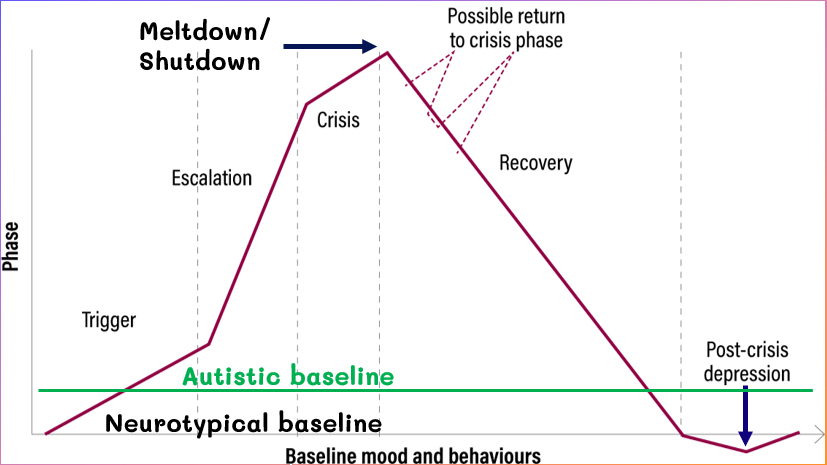
Also known as the Emotional Arousal Cycle, this is a model by Kaplan and Wheeler (1983) that describes the five phases through which a person progresses when triggered into a state of distress. It is useful in understanding how a neurodivergent person reaches the point of Meltdown/Shutdown, starting with the triggering event, escalating to crisis, de-escalating through recovery, and ending up in post-crisis depression, before eventually being able to return to a baseline level of emotional regulation.
Often incorrectly described as “extreme picky eating,” ARFID (term changed from Selective Eating Disorder in 2013) is characterised by a pattern of eating that avoids certain foods or food groups entirely and/or is restricted in quantity (eating small amounts) to the point of not taking in a sufficient amount of nourishment. Research has shown that ARFID and autism frequently co-exist, and people with ARFID are more likely to be autistic than those who don’t experience ARFID.
Specific difficulties with movements needed to make words. This is often experienced by non-speaking people.
A difficult with motor planning and movements; the body always does something different to what the brain intends. Often, this is experienced by non-speaking autistic people.
A controversial yet widely used form of behavioural intervention that relies on coercive techniques to force ‘normalisation.’ The official stated goal of ABA is to ‘make an autistic individual indistinguishable from their peers.’ Autistic adults who were subjected to ABA as children describe it as torture.
A communication impairment – either situational or permanent – that impacts an individual’s speech, as well as the way they write and understand both spoken and written language.
An inability to visualise something in one’s mind.
Mental health conditions related to excessive or unrelenting anxiety. These include, but are not limited to, Generalised Anxiety Disorder, panic attacks, and phobias that limit daily activities.
A natural emotional and physiological response characterized by feelings of fear, worry, or unease, triggered by anticipation of unpredictable or unknown possible outcomes. It becomes problematic when it intensifies, lasts continuously, and/or begins to interfere with daily life. Many neurodivergent people are prone to responding to environmental triggers with intense anxiety.
AAC gives a voice to people who otherwise do not have a way of expressing themselves with understanding to others; AAC Systems are methods of communication used to supplement or replace spoken or written language, ex. speech generating device (voice output), picture-based reference book, a specific app on a phone, etc.
Non-autistic person; not synonymous with neurotypical, i.e., someone can be both ADHD and allistic.
Term coined by Peter Emanuel Sifneos (1972) to describe an internal experience where a neurodivergent person has challenges identifying and describing emotions in the self; there can be difficulty distinguishing between feelings and bodily sensations (interoception). It is sometimes referred to as ‘emotional blindness,’ but that is inaccurate.
Having the right to make intentional decisions, exert control over one’s circumstances, and determine the path of one’s own life and future; the capacity of individuals to have the power and resources to fulfil their potential.
A way of communicating that uses positive, respectful, and validating framing of an individual’s identity and experience.
When a child/young person requires, for any reason, additional or different support in order to benefit from and engage with learning.
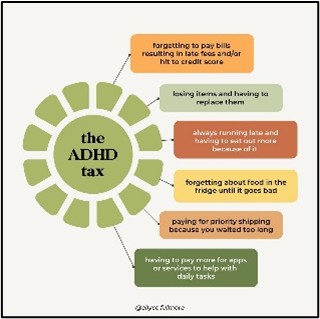
This is the financial, emotional, mental, and physical toll of living with an ADHD brain in a neurotypical world. It involves the cumulative impact of perceived daily “failures” in all areas of life on self-esteem, confidence, and financial health.
Natural neurodevelopmental variation characterised by an abundance of attention dictated by internal drivers, neural hyperconnectivity, high sensitivity to sensory input, monotropism, an interest-driven dopamine system that needs novelty and variety, and varying processing styles; ADHD distress traits include inattention, impulsivity, hyperactivity (physically and/or mentally), and mood instability.
This is a right guaranteed in law to disabled people to receive modifications or adjustments in a learning or work environment that will remove disadvantages and/or enable participation and the opportunity for success, as well as to ensure their rights and privileges are equal to those without disabilities; this right is limited to accommodations that don’t create a disproportionate financial burden to the institution.
Fundamentally, accommodation is about changing the environment around a person, not the person themselves.
Ensuring disability needs are accounted for so that all people can attend and fully participate in a given setting.
The practice of understanding, valuing, & accommodating differences in brain function as a natural aspect of human variation, rather than as a defect; this involves focusing on supporting neurodivergent people in their self-stated goals rather than in seeking to “fix” them.
Physical and social discrimination against disabled bodies based on the belief that typical abilities are superior, and that disabled people require “fixing.”